
5 Proven Ways to Increase Traffic to Your Website in 2026
Anyone can build a website, especially with a no-code builder like Grapes Studio. But getting people to actually visit your site is where the real challenge is.
Data from Ahrefs shows that 96.55% of pages get no traffic from Google, while 1.94% get between one and ten monthly visits.
If you're struggling to drive visitors to your site, this article will show you five proven tactics to increase your website traffic in 2026.
Why Most Websites Struggle to Get Traffic
SEO is a lucrative marketing channel, because it allows you to drive thousands of visitors to your website basically for free.
But it's also one of the most competitive. Millions of new pages are published daily. In most industries, there are already hundreds of pages covering the same topics, often from brands with established authority and larger content teams.
Not to mention, the search landscape has evolved. Users can now get instant answers from AI Overviews, AI Mode, and large language models (LLMs) like ChatGPT without clicking through to a website.
In such a competitive and ever-changing field, your SEO strategy and execution have to be on point if you want to succeed. But this is where I see most websites fall short, especially newer ones.
Here are common SEO mistakes site owners make that result in poor rankings and low traffic:
They target keywords with no search demand: Many site owners choose keywords based on gut feeling or what sounds relevant, rather than actual search data. They end up creating content for queries that receive little to no monthly searches.
Their content isn't aligned with search intent: Even when targeting the right keywords, many sites fail to deliver what searchers actually want. If someone searches "best website builders," they want comparisons and recommendations, not a 2,000-word history of web development.
Their site is full of technical issues: You can have the best content in the world, but it won't matter if Google can't find it, can't crawl it, or can't understand it.
The good news? Each of these problems is solvable with the right strategy.
Step-by-Step Guide to Increase Website Traffic
As an SEO agency founder, I've helped countless brands generate a steady stream of high-quality visitors through the power of SEO. In one particular case, my client went from 1,500 to over 11,000 monthly traffic in just over a year.
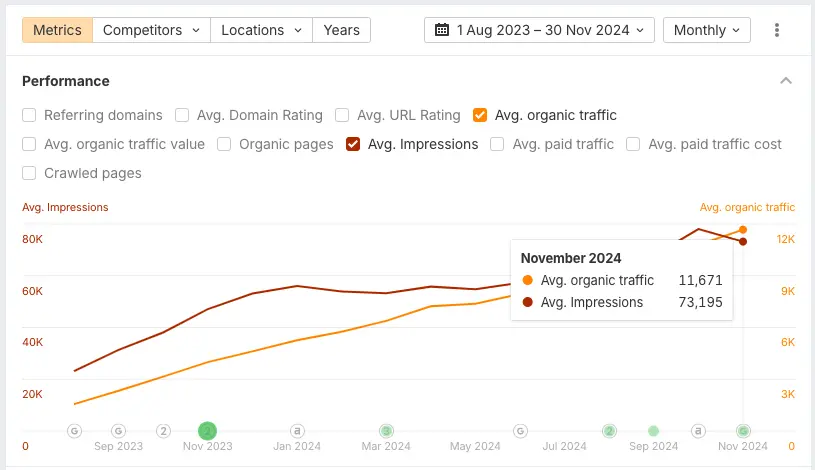
Here are the exact tactics I've used to deliver results for clients across multiple industries.
1. Strengthen Technical Foundation
Before focusing on content and marketing, you need to ensure your website's technical foundation is solid. Even the most brilliant content won't generate traffic if search engines can't properly access and understand your site.
Here's what you need to:
Make sure your important pages can actually be indexed
This might sound obvious, but you'd be surprised how many websites have pages that Google simply can't or won't index.
Open your Google Search Console (GSC) dashboard and go to Indexing → Pages. From there, select to view data about indexed pages and make sure all your important pages are listed there.
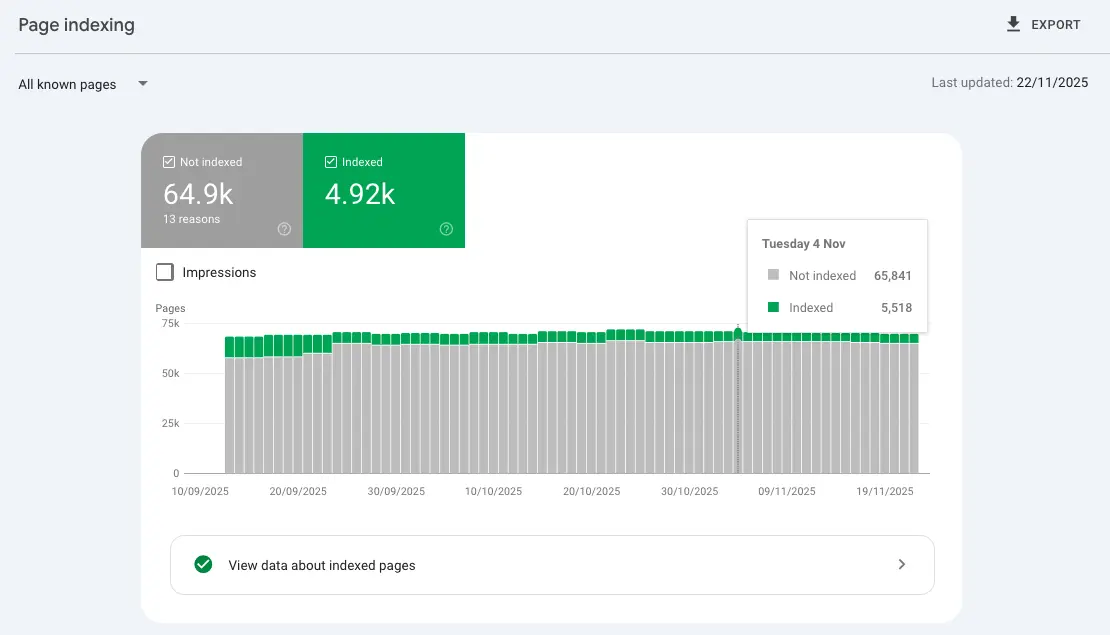
If they aren't, go back to the Page indexing tab and scroll down to the "Why pages aren't indexed" section.
Here, you'll find a list of unindexed pages along with the reasons why those pages aren't indexed, which may include:
- Blocked by robots.txt
- 404 Not Found error
- Redirect issues
- Content duplicate
- Noindex tag
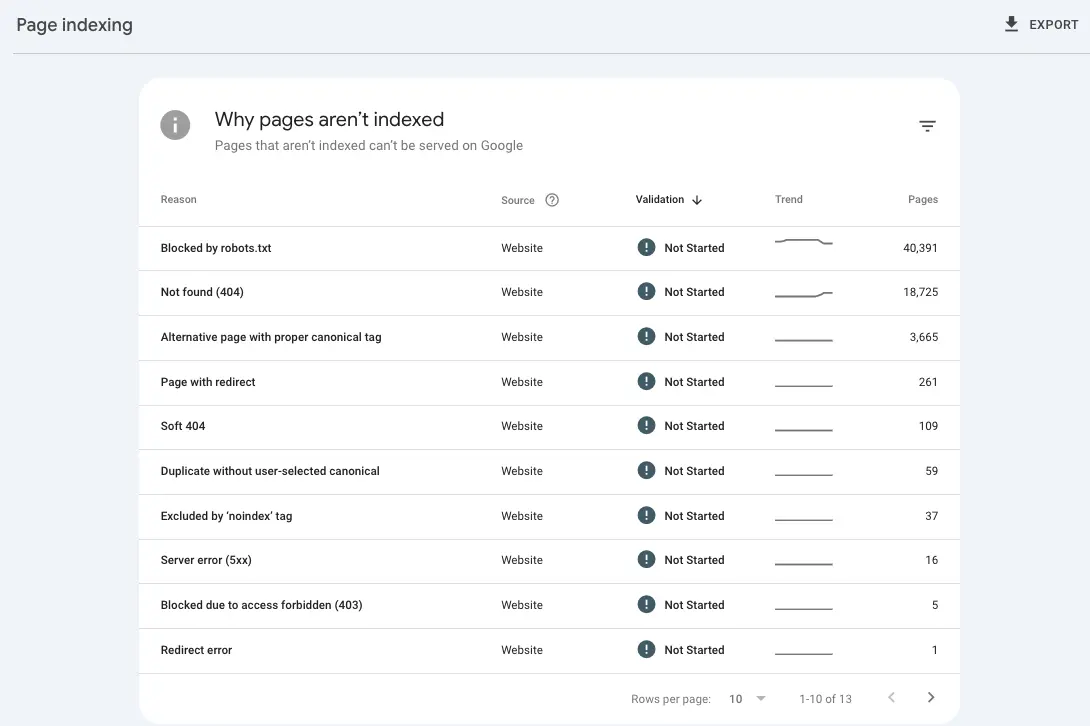
Fix those issues, then submit an indexing request via the URL inspection tab on the left sidebar.
Boost loading speed and improve UX
Google takes user signals seriously. If your site is slow and visitors are bouncing immediately, it sends a clear message that your page isn't providing a good experience, which will hurt your rankings.
Page response time is crucial for AI visibility too. A study by Kevin Indig confirms that LLMs like ChatGPT are more likely to cite pages with faster loading times.
And more importantly, having a slow website can cost you customers. If your site takes too long to load, people will simply abandon it and go to your competitors.
To understand how your site currently performs, you can use a free tool like Google's PageSpeed Insights. Simply enter your URL, and the tool will show you any performance issues along with specific recommendations for improvement.

A few tips to improve your site's loading speed:
- Compress and optimize all images (use WebP format when possible)
- Minimize CSS, JavaScript, and HTML files to reduce their size
- Consider using a content delivery network (CDN) for faster global access
- Remove unnecessary plugins or scripts that bog down your site
- Use a lightweight website builder like Grapes Studio
Optimize for LLM crawlers
Unlike Googlebot, many AI crawlers have limited or no ability to execute JavaScript. That means if your core content is rendered client-side or hidden behind heavy scripts, LLMs may never see it.
To ensure your pages are eligible for AI visibility:
- Make your primary content available in plain HTML
- Avoid relying on JavaScript to load critical text
- Ensure metadata, headings, and body content appear in the initial HTML response
- Keep your markup clean and semantic so crawlers can easily parse it
This is one area where Grapes Studio's static-first approach provides a clear advantage. It outputs clean, lightweight HTML that loads instantly and is fully accessible to both search engines and LLM crawlers.

Improve site architecture
A well-structured website is easier for search engines and AI models to crawl and understand.
Key elements to set up:
- XML sitemap: Make sure it only includes canonical, indexable URLs and submit it to Google Search Console.
- Internal linking: Ensure important pages are linked from multiple places across your site, including the top menu, footer, and relevant blog posts. This helps distribute authority and makes crawling faster.
2. Target Keywords With Less Competition
Many small websites struggle to rank because they go after broad, highly competitive terms dominated by large brands.
A more effective approach is to target long-tail, lower-competition keywords that you can realistically rank for.
To find these opportunities, use keyword research tools like Ahrefs, Semrush, or Google Keyword Planner. Look for longer, more specific queries that:
- Are relevant to your business
- Have decent search volume
- Have low keyword difficulty
For example, instead of "marketing software", go for something more specific like "marketing campaign management software."
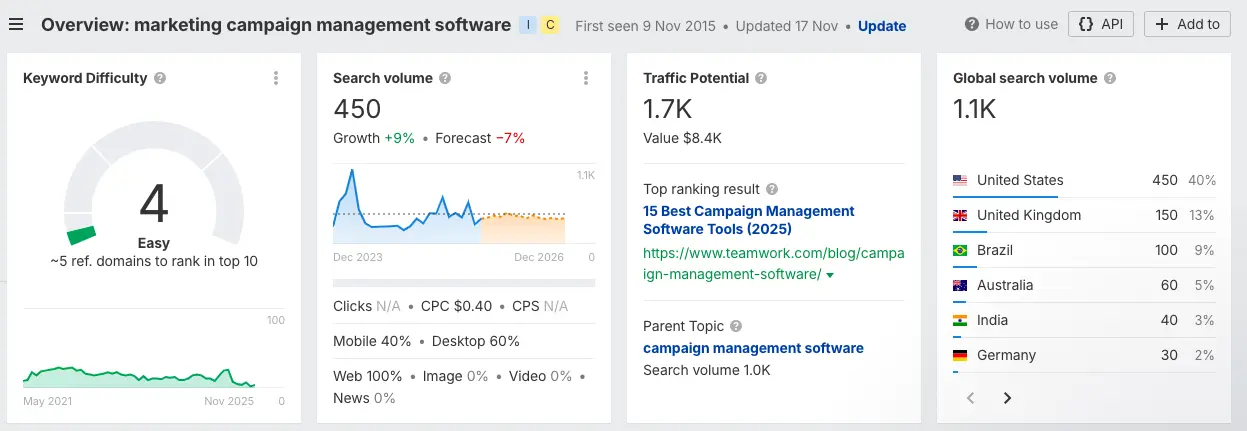
This keyword has the perfect combination of low difficulty score (4) and high global search volume (1,100), which is exactly the type of query you should pursue.
3. Satisfy Search Intent
Once you identify several of these high potential keywords, the next step is to write the content for each of them.
Whether you update an existing piece or create a new one, make sure it meets the search intent. People use Google and ChatGPT for the same reason: to get answers. Your content needs to give them exactly that.
Before you start writing, enter your target keyword on Google and analyze the search results to understand what's already ranking.
Look at:
- The type of content: Is Google showing landing pages, blog posts, comparison pages, listicles, or tutorials?
- The content depth: Are the top pages short 1,000-word educational content or long, comprehensive guides?
- Overlapping headings: What common subtopics or sections those pages cover?
This should give you a clear idea of what Google thinks is the best match for that specific keyword.
But don't just copy them. Create something better.
Look for questions or topics that the top-ranking pages don't cover. These gaps are your opportunity to build a more complete, more helpful resource.
You can uncover them through:
- "People Also Ask" questions
- Related searches at the bottom of the SERP
- Forums, Reddit threads, or community discussions
- Feedback or questions from your own customers
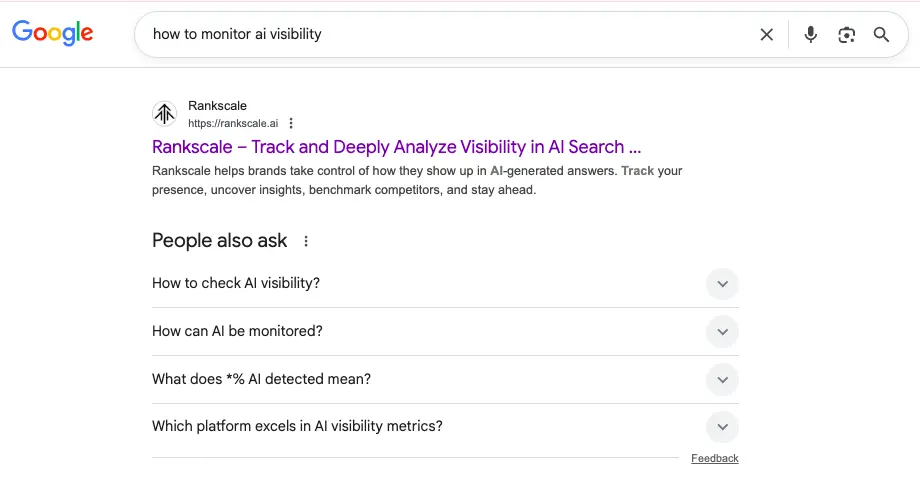
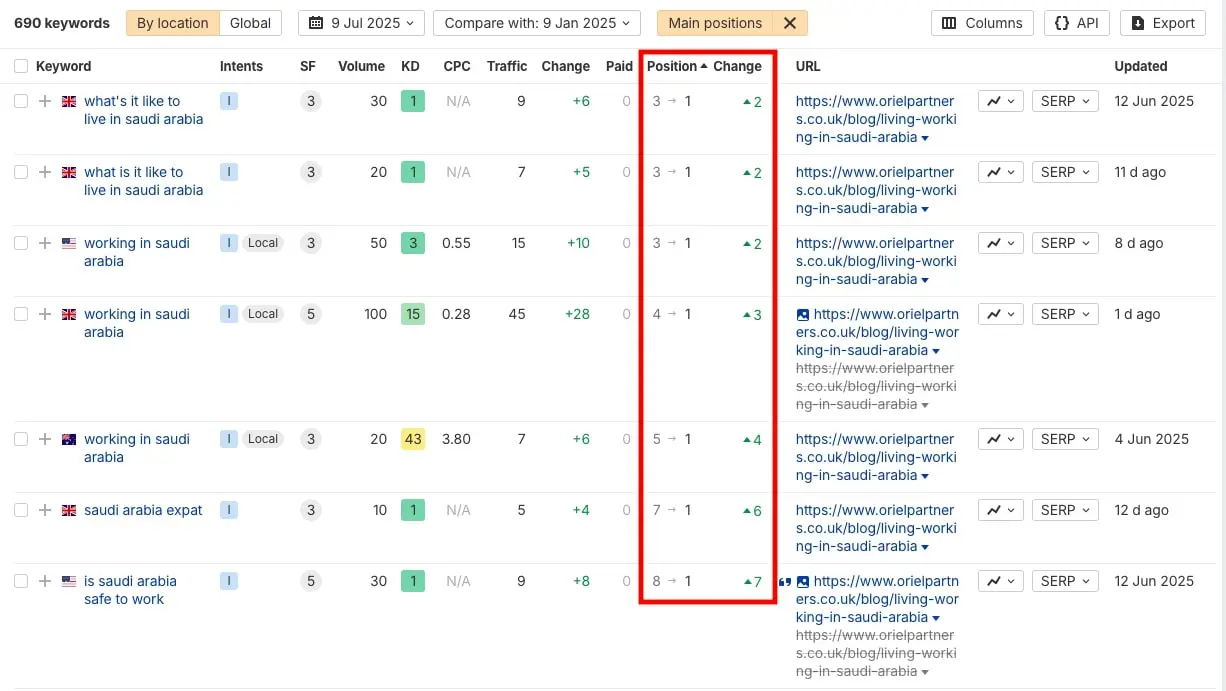
For example, one of my clients was updating a blog post about living and working in Saudi Arabia.
To better satisfy search intent, we dug deep into People Also Ask boxes, Reddit threads, and expat forums to uncover what the target audience actually wanted to know—things like safety, local culture, religion, political situation, etc.
We then used those insights to add more relevant sections that cover all aspects of life in Saudi Arabia.
And it worked. In just 6 months after the update, the article secured top position on Google for 23 keywords and got cited by AI Overviews for 17 keywords. This resulted in a massive 131% increase in organic search traffic.
4. Optimize Metadata to Boost CTR
Even if your page ranks well, users decide whether to click based on the title and meta description they see in the search results. These two elements act as your page's "ad copy" on Google.
Again, it all comes down to understanding the user search intent.
Someone searching for "landing page design" might want inspiration to create their own landing page. So, if your title reads "30 Landing Page Design Examples," they're more likely to click than if it just says "Landing Page Design Guide."
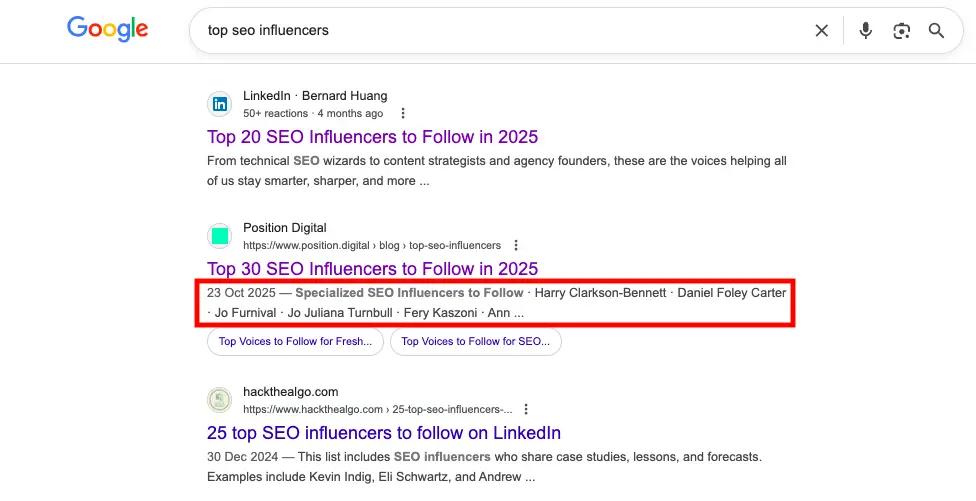
Similarly, a person looking for "top SEO influencers to follow" would want a list of names as quickly as possible. In this case, it's smart to reveal a few of those influencers directly in the meta description, just as we did with one of our own blog posts.
Here are some tips to optimize your metadata:
- Analyze the SERP: Google often rewrites title tags and meta descriptions to serve user intent better. A quick SERP analysis can reveal what Google thinks is good metadata for a given keyword.
- Spill what's inside: Tell users exactly what they'll get if they click through to your content.
- Include your target keyword: This helps search engines and LLMs understand the page's topic, and whether it's relevant to the user query.
5. Borrow an Audience
SEO is a long-term investment. For new websites, it may take months or even years before you finally see meaningful results.
However, there's a quick-win tactic you can do to increase your website traffic faster: leverage the existing audiences of popular platforms.
These include:
- Writing guest posts for high-traffic publications: It's a good way to show your expertise, (subtly) promote your product or service, and link back to your website to get referral traffic.
- Repurposing blog content on social media: Break down your long-form content into short LinkedIn posts, Instagram carousels, or TikTok videos. This helps you reach audiences who might never find you through search alone.
- Contributing to forums like Reddit and Quora: Participate in discussions, answer questions thoughtfully, and link to your resources when relevant. But be careful, as forum users have a low tolerance for spam and promotional content.
- Publishing articles on Medium and LinkedIn: These platforms have a high domain authority, so you'll have more chances to rank your content in search engines.
You can also "borrow" the followers of well-known figures like influencers, podcasters, YouTubers, and journalists.
Collaborating with these creators—through interviews, quotes, collaborations, AMAs, sponsored segments, or expert roundups—instantly introduces your brand to thousands of potential visitors who already trust the host.
Wrapping Up
Anyone can build a successful website with thousands of visitors per month, as long as they implement the right strategy.
Start by getting your foundations right: ensure your site is easy to crawl, loads quickly, and delivers an excellent user experience. Then focus on creating high-quality content that genuinely satisfies your audience's needs, both onsite and offsite.
And finally, don't rely solely on Google. Diversify your traffic sources by tapping into social platforms, communities, and established third-party publishers. The more places your audience can discover you, the faster your traffic will grow.
Remember, SEO is a long-term game. Trust the process, and those small but steady improvements will compound into meaningful growth over time.
About the Author
Sean Begg Flint is the Founder and CEO of Position Digital, an SEO & GEO agency agency that helps B2B companies grow their brand visibility across both traditional search and AI-driven channels. Over the years, he has guided clients through algorithm updates, shifting user behaviour, and evolving search trends. Today, his focus is on helping brands adapt to the rise of LLMs and AI-powered search.